
Choosing a China-based supplier for a Drywall CNC Panel Fabrication Machine requires more than comparing prices. Real production evidence matters. An experienced manufacturer should explain spindle power, cutting speed, vacuum control, and dust extraction in practical terms. These details affect edge quality when gypsum panels are cut for doors, sockets, or curved designs. Factory visits, test videos, and sample panels can reveal more than polished brochures. Look for stable servo systems, accessible replacement parts, clear wiring, and documented safety procedures. Reliable suppliers also provide installation training, operating manuals, and responsive technical support after shipment. Claims about being top should be supported by export experience, customer feedback, and consistent quality records.
A serious evaluation should begin with your panel thickness, daily output, workshop space, and dust environment. Ask the supplier to process your own drawings before signing a purchase agreement. Watch the machine complete a full cycle, including loading, engraving, cutting, and cleaning. Small details matter. Does the table hold thin board without movement? Can operators adjust depth without confusing menus? Are emergency stops visible and tested? These questions sound simple, yet they expose practical weaknesses. No machine is perfect. A supplier that admits maintenance limits may be more trustworthy than one promising unlimited performance. Costs also include tooling, freight, commissioning, software updates, and training. With careful verification, Chinese manufacturing can offer competitive precision and useful customization. This guide examines the evidence behind supplier selection, not merely attractive product language.
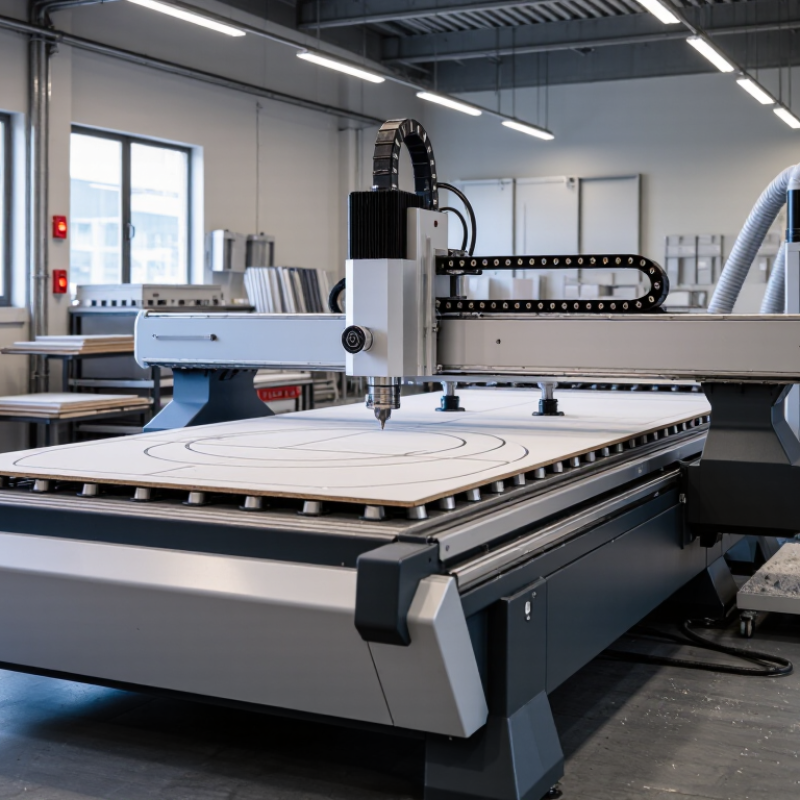
A drywall panel CNC fabrication machine is a computer-controlled system for cutting, routing, drilling, and shaping drywall panels. It follows digital drawings instead of relying only on manual measurements. A typical machine includes a worktable, vacuum or mechanical clamping, cutting tools, motion rails, and control software.
The operator loads a panel onto the table and checks its thickness, size, and surface condition. The software then converts the design into precise tool paths. The machine can create openings for doors, windows, electrical boxes, and ventilation points. It can also produce repeated panels with consistent dimensions. Clean edges matter. Rough cuts may increase installation time and create unnecessary waste.
Accuracy depends on more than the CNC system. Proper calibration, sharp tools, stable panel support, and correct design files are equally important. Dust extraction protects visibility and helps maintain the cutting area. Operators should inspect every setup before production begins. Safety guards and emergency controls must remain functional.
In practical fabrication work, the first cut is not always perfect. A slightly wrong reference point can shift every opening. That mistake is easy to overlook on screen. Physical checking remains essential. Experienced technicians compare the finished panel with the drawing before approving a batch. The machine improves speed and repeatability, but it does not replace professional judgment. Drywall can chip, bend, or break when handled carelessly. Small adjustments may still be necessary.
| Data Dimension | Typical Technical Data | What It Means in Practice |
|---|---|---|
| Machine Definition | Computer-controlled cutting and routing equipment for gypsum drywall panels | Automates accurate panel sizing, openings, grooves, notches, and edge processing |
| Compatible Materials | Paper-faced gypsum board, moisture-resistant gypsum board, fire-resistant gypsum board, and cement-based board | Material selection depends on the cutting tool, dust-control system, and board composition |
| Common Board Thickness | Approximately 6–25 mm | The machine should be configured according to the thickest board required by the project |
| Working Area | Commonly 1,220 × 2,440 mm; larger tables are available for oversized sheets | A working area matching standard board dimensions reduces repositioning and improves productivity |
| Cutting Accuracy | Typically about ±0.2–0.5 mm under suitable operating conditions | Actual accuracy depends on machine structure, calibration, tooling, board flatness, and operating speed |
| Spindle or Cutting Power | Commonly 3–9 kW for routing and cutting applications | Higher power supports thicker or denser boards but may increase energy use and dust generation |
| Typical Cutting Speed | Approximately 8–30 m/min, depending on tool, thickness, and cutting pattern | Production speed should be balanced with edge quality, tool life, and board stability |
| Positioning Speed | Approximately 20–40 m/min on many industrial configurations | Fast positioning reduces non-cutting time between programmed operations |
| Main Fabrication Operations | Straight cutting, circular cutting, rectangular openings, V-grooves, slots, notches, and edge trimming | One programmed setup can prepare panels for doors, windows, electrical boxes, and service openings |
| Control System | CNC controller with CAD/CAM file input, including commonly used G-code workflows | Digital drawings can be converted into repeatable machining programs with fewer manual measurements |
| Workholding Method | Vacuum table, mechanical clamps, or a combined workholding system | Stable holding helps prevent panel movement, edge chipping, and dimensional errors |
| Dust Extraction | Central dust collector or high-capacity extraction system with a suitable filter | Effective extraction improves visibility, protects machine components, and reduces airborne dust |
| Tooling | Carbide or diamond-coated router bits, end mills, scoring tools, and specialized groove cutters | Tool selection affects cutting quality, service life, noise, and processing cost |
| Electrical Requirement | Common industrial supplies include 380–400 V, three-phase, 50 Hz; other configurations may be available | Voltage, frequency, total load, and dust-collector requirements must be checked before installation |
| Automation Level | Manual loading with automatic machining, or integrated loading and unloading for higher production volumes | The suitable level depends on order volume, labor availability, and required production flexibility |
| Typical Applications | Prefabricated drywall systems, modular interiors, ceiling panels, wall partitions, and MEP service openings | Suitable for construction component manufacturers, interior contractors, and panel-processing workshops |
| Key Selection Criteria | Working size, board types, maximum thickness, accuracy, spindle power, dust extraction, software compatibility, service support, and safety features | A complete technical comparison is more reliable than evaluating a machine by cutting speed or price alone |
Note: Technical ranges are representative industry values. Final specifications should be confirmed against the board material, panel dimensions, production volume, local electrical standards, and required machining patterns.
Key parts include a rigid frame, moving gantry, spindle, servo motors, vacuum table, and dust extractor. Small parts matter.
The controller reads CAD/CAM instructions and coordinates gantry movements. The spindle follows programmed paths for holes, grooves, and shaped edges.
The vacuum table keeps the panel stable during cutting. Movement can cause uneven edges, damaged corners, or misplaced holes.
Request several identical test panels using similar gypsum board. Measure holes, slots, and edges with calibrated tools. Compare the first and tenth pieces.
Feed speed, cutting depth, material moisture, temperature, and operator skill all influence results. Faster is not always better. Rough edges may follow.
Inspect the cutting tool, clean the vacuum surface, confirm the work origin, and check safety controls. Test one panel first. Record failed settings, too.
Define crating, electrical requirements, software training, spare tooling, installation, and acceptance standards. Request a test cut with your own panel sample.
Support should include response times, remote diagnostics, maintenance schedules, spare parts, and escalation contacts. Ask for service reports. Vague promises are not enough.
Keep calibration records, photograph wiring and settings, and schedule regular spindle and sensor checks. Dust can accelerate cutter wear. That is easy to underestimate.
A Drywall CNC Panel Fabrication Machine is an automated system designed to cut, shape, drill, and process drywall panels with high consistency and minimal material waste. Its main components typically include a rigid machine frame, CNC control system, cutting spindle or tooling, vacuum table, drive motors, sensors, and dust-collection equipment. By following programmed digital designs, the machine can produce accurate openings, edges, grooves, and panel dimensions while improving production speed and repeatability.
When evaluating China’s top suppliers, buyers should consider structural stability, machining accuracy, software compatibility, operating efficiency, safety features, and ease of maintenance. Important purchasing factors also include customization options, delivery schedules, installation guidance, operator training, spare-parts availability, and responsive after-sales service. A reliable supplier should provide clear technical specifications, practical testing support, and solutions suited to the buyer’s panel materials and production volume. Careful comparison of quality, performance, total operating costs, and service capabilities can help businesses select the most suitable equipment for long-term drywall fabrication needs.