China Top Woodworking CNC Router Manufacturers Guide examines how to evaluate suppliers beyond attractive catalog photographs. The global automation market is expanding, and woodworking factories increasingly require repeatable cutting, carving, drilling, and nesting. The International Federation of Robotics reported 541,302 industrial robots installed worldwide in 2023, with China representing about 51% of annual installations. That figure is not a router count. It does, however, show the country’s strong manufacturing and automation capacity.
Market estimates vary. This gap matters. Grand View Research’s CNC machine market analysis indicates continued global growth through 2030, while MarketsandMarkets also forecasts rising demand for digitally controlled machining equipment. Neither report isolates every woodworking router category, so buyers should avoid treating broad market figures as direct proof of supplier quality. A careful comparison needs machine-level evidence.
This guide focuses on practical details. It reviews spindle power, gantry rigidity, vacuum-table performance, control systems, dust collection, and cutting accuracy. It also considers factory experience, ISO 9001 practices, documented testing, export history, and responsive technical support. A supplier may promise ±0.05 millimeter accuracy, yet the real question is whether that result survives an eight-hour production shift. Ask for test-cut videos, inspection records, component brands, warranty terms, and customer references. Check the machine’s frame welds and cable routing. Small details matter.
Some manufacturers communicate clearly; others do not. That difference deserves attention. Buyers should verify every important claim independently, especially when comparing prices, delivery schedules, and after-sales service. A lower quotation can become expensive after repeated downtime, unclear software support, or unavailable replacement parts. This guide aims to support informed decisions, while acknowledging that no supplier ranking can replace hands-on evaluation and documented performance.
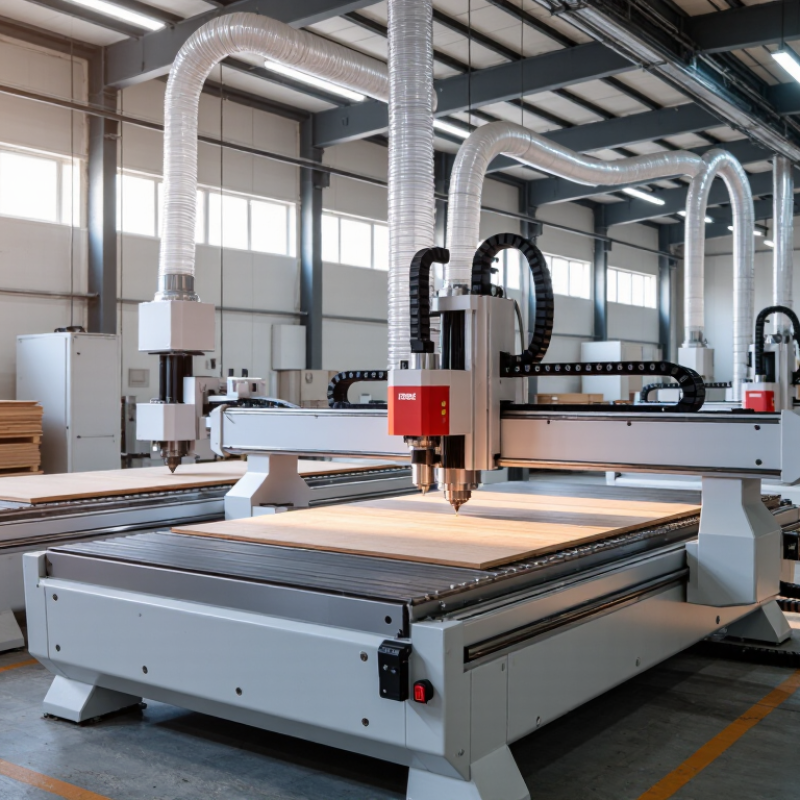
Woodworking CNC routers differ mainly by axis count, cutting access, and setup demands. A 3-axis router moves along X, Y, and Z. It suits cabinet panels, doors, signs, and flat furniture parts. It is usually easier to program, maintain, and train operators on.
A 4-axis router adds a rotary axis, often for cylindrical or indexed work. It can machine chair legs, columns, and shaped components with fewer manual repositioning steps. A 5-axis router tilts and rotates the cutting tool, reaching angled surfaces and deep contours. It supports molds, sculptural furniture, and complex joinery. According to Grand View Research, the global woodworking machinery market was valued at over USD 4 billion in 2023, with CNC adoption supported by demand for accurate, repeatable production. The report also identifies automation as a major market direction.
Configuration decisions should follow actual workpieces, not impressive specifications. A 5-axis machine can reduce setups, but programming, calibration, and operator training become more demanding. That matters.
Data from the International Federation of Robotics shows China installed more than 276,000 industrial robots in 2023, representing over half of global installations. This broader automation trend also influences woodworking factories. Still, robot density does not guarantee better routing results. Buyers should test sample materials, inspect spindle stability, check dust extraction, and confirm after-sales technical support. A 3-axis machine may outperform a 5-axis model when production is mostly flat-panel work.
China Top Woodworking CNC Router Manufacturers Guide
Spindle power and accuracy reveal how a woodworking router will perform in real production. A 3.5–5 kW spindle suits plywood, MDF, and moderate solid-wood work. It can deliver clean edges with suitable tooling and conservative feed rates. Higher power, from 7.5 to 12 kW, supports deeper cuts and longer production cycles. However, power is not precision. Excessive cutting force can expose frame weakness, vibration, or poor tool holding.
A stated accuracy of ±0.05 mm deserves careful examination. Ask whether it describes positioning, repeatability, or finished-part tolerance. These figures are not identical. Thermal expansion, tool runout, dust buildup, and loose couplings can reduce practical accuracy. In shop testing, a calibrated test cut should confirm results across the full working area. Measure several features, not just one. Small details matter.
A rigid gantry, ground rack, stable linear guides, and reliable calibration support consistent machining. The control system should also maintain smooth motion during corners and pocketing. A 12-kW spindle may be unnecessary for a workshop producing thin cabinet panels. It can increase energy use and tooling costs. My own preference is to match spindle capacity with material thickness, daily workload, and dust extraction. A specification sheet can look perfect, yet installation quality remains decisive. That part is often underestimated.
China’s leading woodworking CNC router manufacturers should be evaluated through measurable performance, not catalog claims. ISO 230-2 provides a structured method for checking positioning accuracy and repeatability on machine-tool axes. During a practical review, engineers should record axis travel, environmental temperature, feed rate, and measurement direction. A laser interferometer can reveal small deviations that a finished cabinet may not immediately show. Shortcuts here create unreliable comparisons.
Experienced testers also inspect how machines behave after thermal stabilization. A router cutting oak for several hours may respond differently from one tested while cold. Test results should identify backlash, reversal errors, and variations between repeated movements. These details matter when producing joints, carved panels, or nested sheets with tight tolerances. The control system deserves attention too. Smooth motion cannot compensate for poor calibration.
Manufacturers that share complete test conditions appear more credible. Buyers should request raw measurement data, calibration records, and maintenance guidance. ISO 230-2 testing does not prove every machine is equally suitable for woodworking. It offers a disciplined reference point. That distinction is important. Some evaluations still rely on limited samples, and one machine may not represent an entire production line. I would also repeat tests after transport and installation, because factory performance can change on a workshop floor. Real confidence comes from transparent evidence, consistent measurements, and careful technical questioning.
Objective evaluation framework based on measurable machine-tool positioning performance, documentation quality, and woodworking application requirements
| Evaluation Dimension | Technical Definition | Measurement Unit | ISO 230-2 Reporting Element | Why It Matters for Woodworking CNC Routers | Evidence Required |
|---|---|---|---|---|---|
| Positioning Accuracy | Difference between the commanded position and the position actually reached by the machine axis. | µm or mm | Bidirectional accuracy, commonly reported as A | Influences dimensional consistency when cutting nested panels, joinery, cabinet parts, and repeated components. | ISO 230-2 test report with axis-specific results and test conditions |
| Positioning Repeatability | Ability of an axis to return to the same commanded position under repeated movements. | µm or mm | Bidirectional repeatability, commonly reported as R | Important for repeated cuts, tool changes, workpiece indexing, and production batches. | Repeated positioning measurements recorded at defined target positions |
| Systematic Positional Deviation | Average directional deviation of the measured positions from the commanded positions. | µm or mm | Systematic deviation, commonly reported as M | Helps identify calibration, leadscrew, rack-and-pinion, encoder, or compensation issues. | Calculated values for each tested axis and travel direction |
| Reversal Value | Difference associated with reversing the direction of axis travel at the same target position. | µm or mm | Reversal value, commonly reported as B | High reversal error can reduce accuracy in contouring, pocketing, lettering, and small-radius work. | Bidirectional measurement results at the selected test locations |
| Range of Positional Deviation | Difference between the largest and smallest measured positional deviations within the test series. | µm or mm | Range of positional deviation, commonly reported as E | Provides a concise view of the spread of positioning results along an axis. | Complete measurement dataset or traceable statistical summary |
| Axis Coverage | Each numerically controlled linear axis included in the measurement plan. | Axis designation | Typically X, Y, and Z; rotary axes may be added when applicable | Wood routers often use large X-Y travel for sheet processing and Z travel for tool clearance and depth control. | Axis travel map, machine configuration, and individual axis results |
| Test Conditions | Environmental and machine conditions under which the measurements were performed. | Temperature, humidity, machine state, test date | Required context for interpreting measurement results | Thermal conditions, warm-up state, fixturing, and machine setup can affect positioning performance. | Signed test record including equipment, conditions, and measurement uncertainty |
| Category | Verification Item | Objective Acceptance Basis | Recommended Rating Method | Data Status |
|---|---|---|---|---|
| ISO 230-2 Compliance | Availability of a complete positioning test report | Report identifies the standard, tested axes, measurement equipment, test conditions, and calculated results. | Verified when traceable documentation is supplied | Document-based |
| Measurement Traceability | Calibration status of the laser interferometer, linear scale, or other measurement equipment | Calibration certificate is current and traceable to a recognized national or international measurement system. | Verified or Not demonstrated | Document-based |
| Axis Performance | Accuracy, repeatability, reversal value, and deviation range for X, Y, and Z axes | Results are reported separately for each axis rather than as a single unspecified machine value. | Compare measured values against the purchaser’s tolerance requirement | Test-result-based |
| Mechanical Stability | Machine frame, gantry, guideways, drive system, and table support | Construction details are supported by drawings, inspection records, or repeatable test results. | Technical review; no universal ISO 230-2 pass/fail limit | Application-specific |
| Woodworking Suitability | Compatibility with solid wood, plywood, MDF, particleboard, laminates, and plastics | Tooling, spindle configuration, dust extraction, workholding, and feed-control capabilities match the intended material. | Score against the buyer’s material and production profile | Application-specific |
| Production Repeatability | Ability to maintain dimensions over repeated cycles | Repeatability results are supported by repeated test cuts or documented axis measurements. | Review batch-test records and dimensional inspection data | Test-result-based |
| Technical Documentation | Machine drawings, electrical diagrams, maintenance instructions, and test records | Documents are complete, revision-controlled, and consistent with the delivered machine configuration. | Verified when documentation is complete | Document-based |
| After-Sales Support | Spare-parts availability, training, troubleshooting, and response procedures | Support commitments are defined in writing with service contacts and response terms. | Contract and reference-check review | Commercial review |
| Required Data Field | Correct Reporting Format | Reason for Inclusion |
|---|---|---|
| Working Envelope | X travel × Y travel × Z travel, expressed in mm | Confirms whether the machine can process the intended panel, board, or component size. |
| Maximum Workpiece Thickness | Maximum material thickness in mm, including the selected tooling and workholding arrangement | Prevents misleading comparisons based only on nominal Z-axis travel. |
| Spindle Information | Rated power in kW, speed range in revolutions per minute, cooling method, and tool interface | Determines suitability for roughing, finishing, engraving, drilling, and material-specific cutting. |
| Positioning Results | A, R, M, B, and E values for every tested axis, with units and test conditions | Allows technical comparison using a consistent ISO 230-2 terminology. |
| Machine Repeatability Test | Number of repeated cycles, target locations, measured deviations, and inspection method | Shows whether stated repeatability reflects actual production behavior. |
| Dust Extraction | Port diameter in mm, number of extraction ports, and required airflow in m³/h when specified | Dust control affects cutting visibility, machine cleanliness, tool life, and workplace safety. |
| Electrical Requirements | Supply voltage, phase configuration, frequency, installed power, and protection requirements | Confirms compatibility with the purchaser’s facility. |
| Inspection Record | Machine serial reference, inspection date, equipment identification, operator, and approval signature | Creates a traceable record for acceptance, maintenance, and future service. |
All values and evaluation dimensions in this table are presented as standardized technical fields or verification requirements. No manufacturer-specific performance claim or brand ranking is implied without an independently traceable test report.
China Top Woodworking CNC Router Manufacturers Guide
Factory comparison should begin with bed size, not the sales brochure. A 1320 × 2500 mm bed suits many cabinet panels, while a 1530 × 3050 mm bed handles larger sheets with fewer repositioning errors. However, a wider table needs a stiffer gantry. Bigger is not automatically better. The 2024 MarketsandMarkets CNC machine report identifies automation and flexible production as major market drivers, but productivity still depends on accurate cutting, loading time, and operator skill.
ATC performance needs practical testing. Ask for tool-change time, spindle power, collet standards, and sample results from hardwood and MDF. Vacuum power also requires careful comparison. Pump horsepower alone is incomplete; airflow, vacuum pressure, zoning, gasket condition, and table leakage matter more during daily work. A 7.5 kW pump may perform poorly on a damaged spoilboard. That is an easy detail to miss. CE compliance should include a Declaration of Conformity, risk assessment, electrical documentation, and safety guarding. The European Commission’s 2023 Safety Gate report recorded 3,412 product alerts, reminding buyers that paperwork does not replace physical safety checks.
Tips:
Request a live cutting test using your sheet size and tooling. Measure holding stability at the panel edges. Check emergency-stop response, cabinet wiring, and grounding before purchase. I would also verify the actual pump model and noise level, because catalog figures can be optimistic. Compare service training, spare-part access, and inspection records beside the machine price.
When buying a woodworking CNC router, treat service terms as production tools, not paperwork. Ask for the warranty period, covered components, labor limits, and response times. A clear warranty should separate spindle, drive system, controller, and electrical parts. Request a written exclusion list. Vague promises age badly.
Spare parts need a practical checklist. Confirm prices, stock locations, shipping times, and part-number compatibility. Keep critical items onsite, including fuses, sensors, belts, collets, and controller batteries. The 2023 State of Smart Manufacturing Report found that 97% of manufacturers had invested in, or planned to invest in, smart manufacturing. That investment still fails when one low-cost sensor stops a production cell. Ask for remote diagnostics and documented fault codes. A service promise without measurable targets is weak.
Training should cover machine setup, tool selection, dust extraction, calibration, and safe recovery after an alarm. The 2023 manufacturing skills-gap report projected 3.8 million new jobs could be created by 2033, with 1.9 million potentially unfilled. Operator training is therefore an operating requirement, not a courtesy. Define service KPIs before signing: first-response time under four hours, remote-resolution rate above 70%, parts dispatch within one business day, and annual uptime above 95%. These figures need adjustment for workload and climate. I would also test the support line before purchase. It may expose uncomfortable delays.
Suggested minimum contract benchmarks for evaluating warranty coverage, spare-parts planning, operator training, and after-sales service. Confirm each target in the purchase contract before placing an order.
It moves along X, Y, and Z axes. It suits cabinet panels, doors, signs, and flat furniture parts. Programming is usually easier. Training is simpler too.
A 4-axis router adds rotary movement. It can machine chair legs, columns, and cylindrical components. Fewer manual repositioning steps may improve consistency. Setup still needs attention.
A 5-axis router reaches angled surfaces and deep contours. It suits molds, sculptural furniture, and complex joinery. Programming becomes harder. Calibration matters greatly.
Not automatically. Choose according to actual workpieces and production volume. A 3-axis router may outperform a 5-axis model on flat panels. Impressive specifications can mislead.
A 3.5–5 kW spindle suits plywood, MDF, and moderate solid wood. A 7.5–12 kW spindle supports deeper cuts and longer cycles. Higher power is not always better.
No. Power is not precision. Excessive force may reveal vibration, frame weakness, or poor tool holding. A thin cabinet panel may not need 12 kW. Energy costs also rise.
Ask whether it means positioning accuracy, repeatability, or finished-part tolerance. These measurements differ. Thermal expansion, tool runout, and loose couplings can reduce practical results. Test several features.
Request raw test data and calibration records. Review axis travel, temperature, feed rate, and measurement direction. Use calibrated test cuts across the working area. Test it yourself.
Transport and installation can change performance. A router cutting oak for hours may behave differently when cold. Check backlash, reversal errors, and repeated movements. Factory results may not fully transfer.
Inspect the gantry, linear guides, rack, control system, spindle stability, and dust extraction. Confirm technical support and maintenance guidance. I may underestimate installation quality sometimes. It remains decisive.
This guide explains how to evaluate a Woodworking CNC Router for professional and industrial applications. It compares 3-, 4-, and 5-axis configurations, highlighting how each design affects cutting flexibility, machining complexity, and production efficiency. Key specifications include spindle power ranging from 3.5 to 12 kW and positioning accuracy of approximately ±0.05 mm, helping buyers match machine performance with their material and workload requirements.
The guide also presents a practical framework for comparing Chinese manufacturers through ISO 230-2 testing standards. Important factory factors include working-bed dimensions, automatic tool changers, vacuum power, electrical safety, and CE compliance. A purchasing checklist covers warranty terms, spare-parts availability, operator training, technical support, response times, and other service KPIs, enabling buyers to select equipment with reliable long-term performance and manageable operating costs.