
Engineered for extreme structural loads, rapid granite milling, quartz countertop edging, and complex 3D marble relief carving. Compare specs and select your production model below.
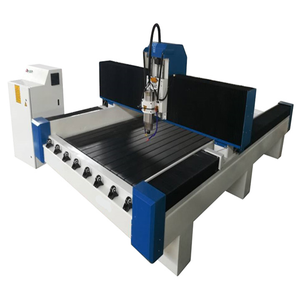
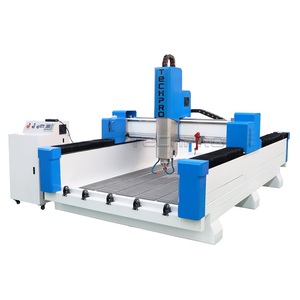
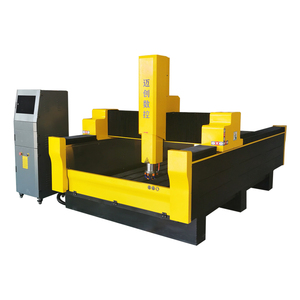
Stone routing presents physical challenges distinct from woodworking or aluminum machining. Stone materials possess non-homogeneous Mohs hardness, high abrasive wear coefficients, and severe structural resistance.
Every frame undergoes thermal tempering and vibration stress relief (VSR) to eradicate internal stress points. This structural foundation prevents bed distortion during decade-long continuous heavy granite wet-cutting.
Utilizing anti-backlash C3 grade pre-loaded ballscrews on the Z-axis and precision helical rack-and-pinion drives on X/Y axes ensures zero positional chatter during high-torque profiling operations.
Industrial stone cutting generates abrasive stone slurry. Machines feature fully enclosed stainless steel accordion bellows, labyrinths, and IP67 sealed linear guides to ensure smooth operation.
The global stone processing machinery market has undergone a structural revolution over the past decade. The shift from manual hand-finishing and basic bridge saws to multi-axis Stone CNC Routers has unlocked extraordinary processing speeds, higher material yields, and unprecedented edge geometry capabilities. When evaluating a stone router factory, industrial buyers must look beyond static dimension charts and evaluate dynamic performance factors: vibration absorption coefficients, spindle torque response under hydraulic water-cooling pressure, and kinematic motion algorithms during multi-axis interpolation.
Key Engineering Insight: Granite (Mohs Hardness 6–7) and Quartzites demand high spindle torque at lower rotational velocities (6,000–12,000 RPM) to prevent diamond matrix burn, while Engineered Sintered Stone (Porcelain Slabs) requires high-frequency vibration damping to prevent edge chipping along micro-fissures.
A professional stone CNC machine differs fundamentally from standard woodworking machines in five core mechanical domains:
Selecting the right drive configuration directly affects operational efficiency, machine life, and precision tolerance over years of operation:
| Machine Architecture | Target Materials | Kinematic System | Max Cutting Feedrate | Primary Industry Application |
|---|---|---|---|---|
| 3-Axis Heavy Monoblock Router | Granite, Marble, Quartz, Slate | Helical Rack + Precision Linear Rails | 12,000 – 18,000 mm/min | Tombstones, Gravestones, Flat Countertops |
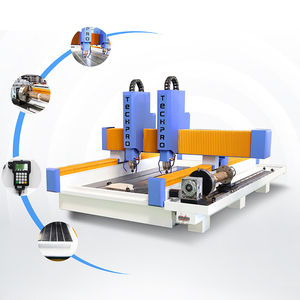
| 4-Axis Rotary Headstock Router | Marble, Limestone, Sandstone | Servo Direct Drive + Harmonical Reducer | 8,000 – 14,000 mm/min | Roman Columns, 3D Statues, Pillar Capitals |
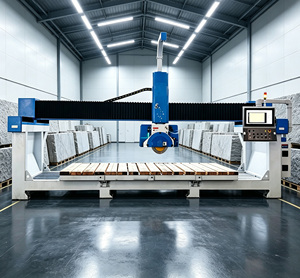
| 5+3 Axis CNC Cutting Center | Sintered Stone, Granite, Quartzite | Absolute Encoder Servos + RTCP Kinematics | 15,000 – 25,000 mm/min | Complex Architectural Facades, Curved Sinks |
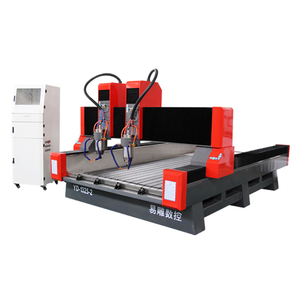
| Dual-Spindle Synchronous Router | Granite & Marble Gravestones | Dual Independent Z-Carriages / Rack-Drive | 10,000 – 16,000 mm/min | High-Volume Tombstone Batch Production |
Evaluating global machinery manufacturers requires analyzing production capabilities, structural engineering standards, factory Quality Control (QC), and long-term tech support. Below is an industrial analysis of the market leaders defining stone CNC router technology today:
Techno CNC Systems stands as a premier authority in industrial routing platforms. Renowned for ball-screw drive systems, stress-relieved steel gantry frames, and dedicated US-based application engineering support, Techno platforms are widely deployed across high-end millwork, stone counter creation, and rigid material fabrication facilities worldwide.
Prussiani is an Italian pioneer specializing in heavy 5-axis CNC machining centers and bridge saws for natural stone. Known for high mechanical accuracy and patented kinematics, their machines cater to ultra-premium architectural stone fabricators.
A division of SCM Group, CMS produces industrial stone routers and waterjet cutting centers. Their strength lies in automated production lines, heavy bridge structures, and specialized CAD/CAM software integrations for complex profile milling.
Breton is synonymous with large-scale industrial stone processing equipment and engineered stone plant manufacturing. Their high-speed 5-axis machining centers are optimized for aerospace-grade tolerances on massive stone blocks.
Park Industries focuses heavily on countertop fabrication equipment for North American fabricators. Their hybrid CNC saws and routers emphasize fast cycle times and simplified operator control interfaces.
Intermac (the glass and stone division of Biesse) delivers world-class CNC work centers designed for profiling, edging, and polishing sink cutouts with extreme surface polish repeatability.
BACA Systems has established a stronghold in robotic stone saws and specialized CNC routers, utilizing industrial robotic arms paired with high-torque water-cooled cutting heads.
Leading Chinese stone router factories lead the market in structural versatility, high-torque dual-head carving setups, and cost-effective heavy 1325/2030 series machines, offering incredible ROI for tombstone carving and monument manufacturing workshops.
Denver produces compact 3-axis and 4-axis stone work centers tailored for small to medium-sized stone workshops seeking solid construction in tight footprints.
Specializing in 5-axis CNC bridge saws and multi-functional milling machines, Donatoni is celebrated for dynamic software controls and high material yield efficiency across natural stone slabs.
As fabricators face rising material costs—particularly with high-value engineered quartz slabs and fragile sintered porcelain—the requirements placed on CNC stone router factories are evolving rapidly. Key technological trends redefining equipment purchases include:
Legacy stone routers relied on simple 3-axis planar motion, requiring manual repositioning of heavy stone slabs for mitered edges or undercut sinks. Advanced 5-axis machines feature RTCP kinematics, enabling the cutter head to maintain an exact focal contact point along 3D spatial curves. This technology streamlines 45° miter cuts for seamless waterfall countertop edges.
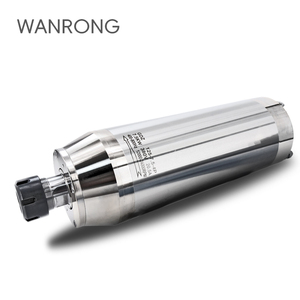
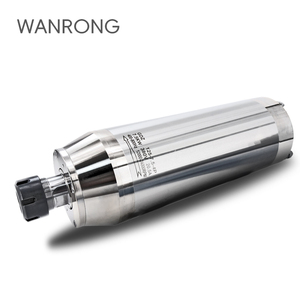
Next-generation water-cooled spindles incorporate embedded multi-axis accelerometers and thermal sensors. By monitoring real-time vibration spikes, the machine control unit can automatically adjust feedrates before diamond tool glazing occurs or before bearing damage takes place—preventing catastrophic spindle failure.
Sintered stone slabs contain high internal residual tension. Standard plunge milling strategies often result in slab cracking. Future-ready CNC routers integrate smart CAM algorithms that perform perimeter tension-relief kerf cuts before completing sink dropouts, lowering material scrap rates drastically.
Environmental regulations worldwide are mandating water conservation in stone factories. Modern stone routers are shipped with integrated sub-bed collection troughs, high-velocity slurry evacuation pumps, and compact flocculant water recycling systems that reclaim 95%+ of process water.
Compiled by senior application engineers to address real-world purchasing questions from production managers and factory owners.
Granite requires high torque at lower RPMs (typically 6,000 to 10,000 RPM) to prevent overheating diamond sintered bits. A 5.5kW to 7.5kW heavy-duty bullet water-cooled spindle with 4 ceramic bearings is recommended. Marble, being softer and non-abrasive, can be cut efficiently at higher RPMs (12,000 to 18,000 RPM) using smaller diamond finger bits or carbide tooling.
Match your bed footprint to raw slab supply lines. A standard 1325 bed size (1300mm x 2500mm / 4x8 ft) is ideal for gravestones, tombstones, and smaller vanity tops. However, standard kitchen countertop jumbo quartz slabs measure roughly 63" x 126" (1600mm x 3200mm). For full-slab countertop nesting and sink cutouts without manual re-positioning, a 5x10 ft or larger bed with a open gantry design is essential.
Calculated ROI typically spans 6 to 14 months based on three primary factors: 1) Labor reduction—one CNC stone router replaces 3 to 4 manual hand-grinders; 2) Material savings—optimized nesting software reduces slab waste by 12–18%; 3) Expanded capabilities—ability to sell high-margin 3D textured panels, drainboard fluting, and complex mitered profiles.
Ensure the manufacturer installs fully enclosed stainless steel armor or heavy accordion dust bellows over X, Y, and Z axes. Furthermore, look for centralized automatic lubrication pumps that push fresh oil through linear guide truck seals continuously, flushing out any micro-grit before it can wear linear bearings.
Air-cooled spindles rely on internal fans that draw surrounding ambient air through the motor casing. In a stone shop, this fan sucks in airborne water mist laden with stone dust, destroying electrical windings rapidly. Water-cooled spindles feature a sealed closed-loop water jacket with zero internal air suction, making them mandatory for stone cutting.
Confirm that your machine supplier provides live factory-trained engineer support, same-day spare parts dispatch (such as replacement water pumps, spindle collets, limit switches, and drivers), remote internet diagnostic capabilities, and detailed G-code post-processors compatible with standard CAD/CAM platforms like Artcam, Alphacam, or Mastercam.